

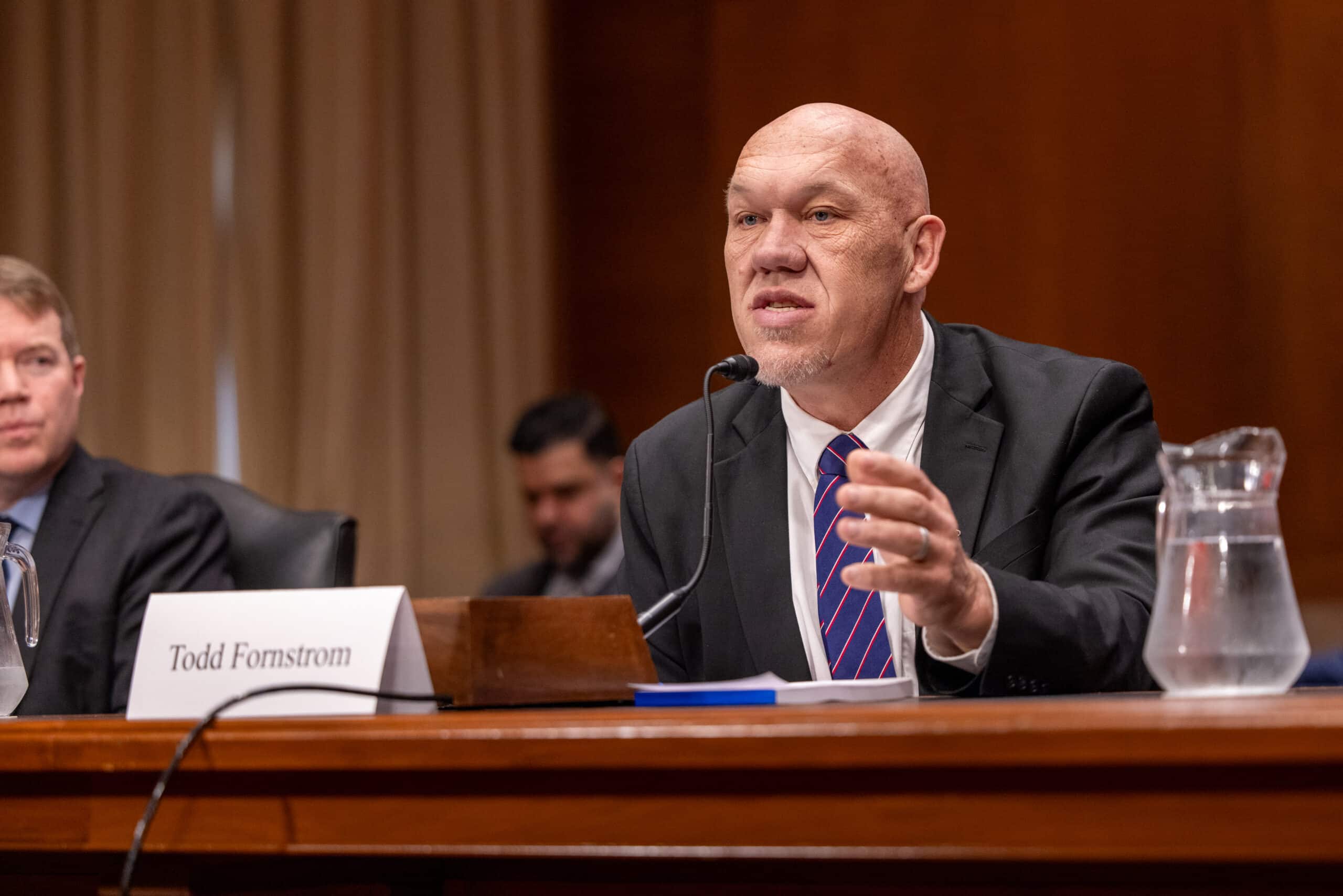
Wyoming Farm Bureau Federation President Todd Fornstrom testified Wednesday before the U.S. Senate Environment and Public Works Committee on the impacts diesel exhaust fluid (DEF) requirements have on farmers and ranchers. The hearing examined S. 3135, the Cold Weather Diesel Reliability Act, legislation aimed at addressing reliability issues diesel-powered vehicles and equipment face in freezing temperatures.
Fornstrom, a fourth-generation farmer from Pine Bluffs, spoke on behalf of nearly 12,000 Wyoming Farm Bureau members and more than five million members of the American Farm Bureau Federation.
“Clean air and water are essential to successful farms and ranches,” Fornstrom said. “Agriculture depends on natural systems, and the quality of the air and water surrounding a farm strongly influences crop growth, soil health, livestock well-being and overall productivity.” Fornstrom explained that while DEF systems were introduced to reduce emissions from diesel engines, they have created operational challenges for agriculture. Equipment used on farms often operates in extreme conditions, including freezing temperatures, dust and vibration, which can affect the reliability of DEF tanks, pumps and sensors.
“Living and farming in Wyoming, dealing with DEF in the winter can feel like a battle against both the cold and the clock,” Fornstrom said. “If DEF freezes or the system triggers an engine derate, it can bring a tractor or combine to a halt right in the middle of critical planting or feeding windows.”
The Cold Weather Diesel Reliability Act would allow manufacturers to suspend automatic engine derates or shutdowns when temperatures fall below freezing and would require the Environmental Protection Agency to provide exemptions for equipment operating primarily in cold regions.
Fornstrom thanked Sens. Dan Sullivan of Alaska and Cynthia Lummis of Wyoming for introducing the legislation to address the challenges DEF systems pose in cold climate and urged Congress to address the broader challenges DEF systems pose for farmers and ranchers.
“The agricultural community believes Congress should go further and carefully weigh the environmental benefits of DEF systems against their reliability issues and economic costs,” Fornstrom concluded. “Farmers and ranchers are calling for the elimination of DEF requirements on agricultural equipment so producers can focus on productivity, efficiency, and feeding our country.”
Read President Fornstrom’s testimony here.
####
WYFB – 2026