

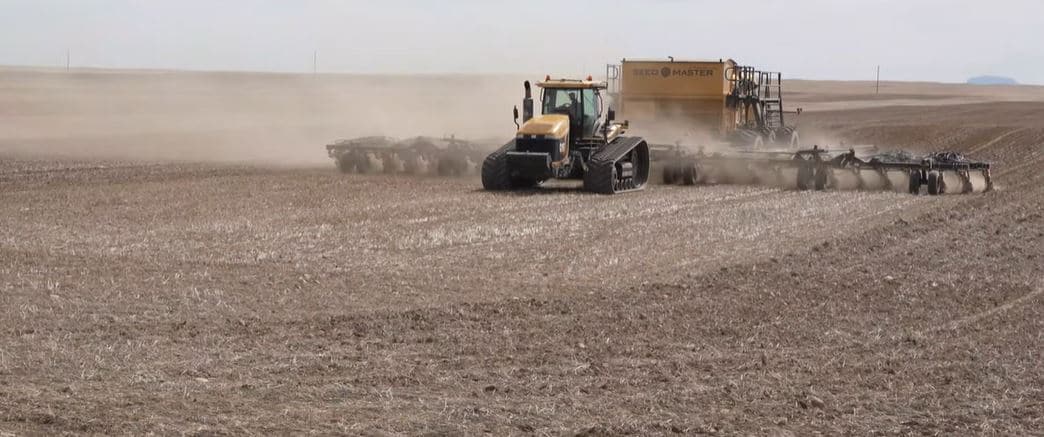
Many Montana producers are preparing to plant nearly a month earlier than average this spring. Early field access provides advantages, including workload management and moisture capture, particularly in a year when drought is a concern.
However, planting ahead of schedule also increases exposure to frost damage and early-season disease pressure from pathogens such as Pythium and Rhizoctonia, which thrive when seeds germinate slowly in cool soils. This AgAlert courtesy of MSU Extension summarizes key early-planting considerations related to disease and insect pressures, agronomic conditions, and nutrient management.
Early-season disease risk and management
Planting early could mean planting into colder soil, which slows germination and seedling emergence. This gives soilborne pathogens like Pythium and Rhizoctonia more time to infect seeds and seedlings. While both pathogens are active at a broad temperature range, cool soil temperatures of 41 to 54 degrees can favor severe infections. Virtually all field crops grown in Montana, including pulses and cereals, can be hosts to Pythium and Rhizoctonia. Among pulse crops, chickpeas and especially large-seeded Kabuli types, are especially susceptible to Pythium and Rhizoctonia.
Management of early-season seedling and root rots can be accomplished by integrating different strategies:
- Monitor soil temperature at seeding depth. Soil temperature needs to be high enough to allow for seed germination and seedling growth. The minimum temperature required for germination varies by crop. For example, spring wheat 37 degrees F, spring barley 40 degrees F, field peas and lentils 40 degrees F, oats 43 degrees F, chickpea 45 degrees F, and spring canola 50 degrees F.
- Choose high-quality seed with strong vigor.
- Select efficacious seed treatments, particularly those labeled for Pythium and Rhizoctonia suppression. Mefenoxam/metalaxyl and ethaboxam are effective against Pythium, while DMI fungicides (FRAC 3, triazoles) have good efficacy against Rhizoctonia. Choose a seed treatment with multiple modes of action for broad-spectrum protection. Consult the MSU Extension treatment guides/tables for both cereal and pulse crops for an overview of seed treatment options (see resources below).
- Avoid planting into waterlogged or compacted soils, where oxygen deprivation also increases susceptibility to infection.
- Adequate phosphorus nutrition reinforces the plants cell walls (lignin deposition), which creates a physical barrier for root pathogens like Pythium.
- For organic production systems: There is limited data on the effectiveness of organic seed treatments for root rot control. In the absence of effective treatment options, implementing good cultural practices (see above), especially paying attention to soil temperature, will be critical.
It is important to point out that while early planting bears certain disease risks, it also offers disease management benefits. For pulse crops, Aphanomyces and Fusarium root rots are a particular threat to field peas and lentils. These diseases are favored by warm soils, and therefore planting early helps crops escape the severe impact of Aphanomyces and Fusarium root rot because plants will be more developed at the time of infection. Using fungicide seed treatments with efficacy against Pythium and Rhizoctonia (and Fusarium) is integral to the success of this strategy.
Early-season insect pests
Common early-season insect pests include wireworms, cutworms, flea beetles, and pea leaf weevil. These insects mostly attack roots or young seedlings when plants are most vulnerable. Similar to soilborne pathogens, environmental conditions that slow crop emergence and early growth can increase the likelihood and severity of insect injury because plants remain susceptible for a longer period.
Wireworms are among the most important soil-dwelling insect pests of cereals and pulse crops. Wireworms feed on germinating seeds, roots, and underground stems, resulting in poor germination, missing plants, and patchy stands. Wireworms become active when soil temperatures reach 45 degrees F.
Cutworms can injure seedlings of many field crops, including cereals, pulses, and oilseeds. Larvae live in the soil and feed mainly at night, cutting seedlings at or just below the soil surface. Damaged plants often wilt and die, leaving irregular patches of missing plants across the field. Fields with high residue or early-season weed growth can favor cutworm populations. Cutworms become active once temperatures get up to about 40 degrees F during the day.
Flea beetles can damage emerging crops, particularly canola and other brassicas. Adult beetles feed on cotyledons and young leaves, producing the characteristic “shothole” feeding injury. Seedlings are most susceptible during the first few weeks after emergence. Early-season adult outbreaks are often localized to field edges. Flea beetles become active after the temperature reaches 55 degrees F.
In peas, early planting can trigger adult activity of pea leaf weevil on emerging seedlings. Feeding damage appears as distinctive U-shaped notches along leaf margins. While adult feeding is often minor, it is indicative of the presence of larvae that later feed on root nodules, reducing nitrogen fixation and plant vigor. Pea leaf weevils begin to move into pea field from overwintering sites once temperatures reach about 55 degrees F.
Management of early-season insect pests:
- Seed treatments with systemic insecticide can help protect seedlings from early feeding by insect pests during crop establishment. Broflanilide seed treatment in small grains can provide good wireworm control, while neonicotinoids help protect oilseed crops against flea beetles and pea against pea leaf weevil.
- Regular field scouting during early crop development is critical to detect pest activity before populations reach damaging levels. Monitoring fields for symptoms such as poor emergence, missing plants, clipped seedlings, or feeding damage on cotyledons and young leaves can help identify insect pest problems early and support timely management decisions.
- Foliar applications are justified when economic thresholds (ET) are reached. Below are links to help identify ETs for these pests in different crops. Note that cutworms come to the soil surface at night to feed on plants, and applications made close to nightfall are generally more effective for most insecticides registered for cutworm control.
- Weeds can serve as alternative hosts and shelter for some of these insects (e.g., cutworms, flea beetles), allowing populations to build before crops emerge. Controlling weeds before planting and during early crop establishment can reduce pest pressure and limit movement of insects into newly emerging crops.
Agronomic considerations for early-season planting
By March 7, soil temperatures at 10 inches had already hit 47 degrees in some parts of the state, a record for that date. That matters because cool-season crops like spring wheat, barley, and lentils can start germinating once soils stay above 40 degrees. Getting seed in the ground now means crops can flower and fill grain before the brutal heat of mid-July. It also lets you tap early spring moisture before warmer temperatures dry out the soil.
However, Montana just had its 5th driest January on record. Mountain snowpack on March 1 was 60 to 95% of normal for much of the state, and drought now covers 95% of Montana. Late frosts are still a threat, too. In western and northern parts of the state, killing frosts may occur one to two weeks later than usual, potentially as late as the end of May in some areas. These conditions mean early planting should be based not only on temperature, but also on soil moisture, seedbed condition, and local frost risk.
So what should you actually do?
Spring wheat can go in once soil temperatures at a 2″ depth hold consistently above 40 degrees. If you are in northern Montana where wheat stem sawfly is a problem, stick with solid-stem varieties. Barley is more time-sensitive: aim to finish planting by mid-April. After May 1, every day you wait costs you roughly a bushel per acre in potential yield.
Pulse crops including lentils and chickpeas are especially well-suited to this year’s dry conditions. Lentils only need about 10 inches of total moisture to produce a crop, and they can germinate at the same 40 degree threshold as wheat, so you can establish them early. They are also frost-tolerant, which takes some of the gamble out of planting ahead of schedule. If you are in southern or central Montana, chickpeas should go in within one to two weeks of spring wheat. That timing lets them flower before summer temperatures push past 90 degrees. Above that, yields suffer.
One more thing worth checking before you plant: your crop insurance. Federal rule changes have removed certain buy-up options for prevented planting coverage, so what you carried last year may not match what is available or what you need this season. Review your policy now, before something goes wrong.
The bottom line: Take advantage of the warm temperatures and early planting window, but keep the drought in mind. Know your field conditions, check your insurance, and plant what your operation can realistically handle this year.
Fertilizer Considerations
Fertilizer needs should not change greatly with early seeding. The soil at early seeding time will be presumably similar in temperature as seeding time in a ‘normal’ year which partially drives the recommendation to place very immobile nutrients like phosphorus and metal micronutrients (copper, manganese, iron, and zinc) with the seed.
Nitrogen fertilizer guidelines won’t change based solely on early seeding, but are largely based on yield goal, which might have lowered from typical based on below normal over-winter precipitation in most of the state. If there is normal growing season precipitation, then early seeding could actually increase yield potential, because flowering and grain fill could occur before Montana’s typical hot, dry period in early summer.
The best recommendation is likely to fertilize with nitrogen conservatively, given low soil moisture and relatively high nitrogen fertilizer costs, and then apply nitrogen during the growing season if precipitation is normal or above normal.
###
MSU Extension
Uta McKelvy, Plant Pathology – Tiziana Oppedisano, Entomology – Eeusha Nafi, Agronomy – Clain Jones, Soil Fertility