

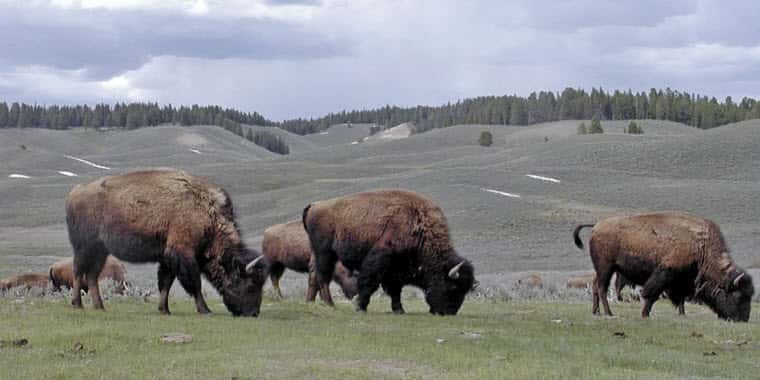
American Prairie has challenged a Bureau of Land Management (BLM) decision that revokes grazing permits used by the group’s bison herd in north-central Montana. The federal agency’s January decision reversed its own 2022 grazing authorization and triggered a 15-day protest period. Earthjustice and Helena-based Cochenour Law submitted the protest on American Prairie’s behalf, arguing that the agency’s decision reverses decades of longstanding practice from BLM on grazing and conflicts with Montana state law.
Protests were also filed by the Coalition of Large Tribes (COLT) which represents more than 50 tribes with the largest land bases and more than half the Native American population, as well as the Cheyenne River Sioux Tribe, the Cheyenne and Arapahoe Tribes, Defenders of Wildlife, and Western Watersheds Project. The Tribes warn this would effectively bar Tribal bison herds nationwide, undermining treaty rights, food sovereignty, and cultural survival.
“This proposal is an unprecedented reversal of BLM’s own decision-making after more than 40 years of treating bison as eligible livestock under federal grazing law,” said Alison Fox, CEO of American Prairie. “BLM lawfully approved these permits after a thorough environmental review and defended them for years. Abruptly rescinding them now—under political pressure—creates immense uncertainty and sends a chilling signal to Tribes, ranchers, and conservation partners who depend on fair and predictable public land management.”
In 2022, the BLM approved American Prairie’s plan to allow bison grazing on 63,000 acres of public lands in north-central Montana. The state of Montana, North and South Phillips Grazing Districts, Montana Stockgrowers Association, and Montana Farm Bureau Federation appealed the decision.
Under the Biden Administration, the BLM defended its decision to issue permits for American Prairie’s bison from summer 2022 until February 2025, when under the new administration the BLM sought a voluntary remand to reconsider the decision. After nearly a year and following a letter from Governor Gianforte to the Secretary of the Interior, on January 16, 2026, BLM issued a Notice of Proposed Decision that the agency had reversed its prior position and proposed a rescission of the permits.
“This BLM decision puts at risk not just American Prairie’s bison grazing, but the management of bison herds across the country, including tribal herds,” said Jenny Harbine, managing attorney for Earthjustice’s Northern Rockies Office. “This shortsighted political decision would reverse decades of precedent and harm public land management moving forward. The agency must withdraw its proposal and restore the grazing permits.”
Governor Greg Gianforte hailed the decision by Interior Secretary Doug Bergum as a win for Montana’s ranchers, rural communities and the rule of law. “For years, we have raised serious concerns about the federal government’s failure to listen to the folks who live and work the land,” Gianforte said. “By proposing to cancel these permits, BLM is finally acknowledging that federal overreach cannot come at the expense of our local communities and the production agriculture that feeds our nation.”
“We have always said that the law is clear: grazing permits under the Taylor Grazing Act are for domestic livestock production, not for creating a massive nature reserve that displaces families who have stewarded this land for generations,” Gov. Gianforte continued. “We must ensure that public lands remain accessible and productive, rather than being locked away for the vision of special interests.”
The Montana Stockgrowers fought the 2022 decision due to the lack of process followed and the violation of the Taylor Grazing Act. “MSGA is thrilled to see this decision by the BLM to restore grazing allotments back to their intended usage for production livestock grazing, affirming what ranchers have been saying since the beginning of this process,” Lesley Robinson, MSGA President stated. “MSGA is proud to defend sound, lawful land management.
“BLM’s proposed decision is a win for ranchers and rural areas that rely on production agriculture for the very fabric of their communities,” said Montana Farm Bureau Federation Executive Vice President Scott Kulbeck. “Returning Bureau of Land Management allotments to grazing livestock infuses those communities with dollars spent on production practices, a stable tax base and most importantly the families that care for those allotments who add to the vitality of rural Montana.”
###
American Prairie/Gov. Gianforte/MSGA/MFBF