

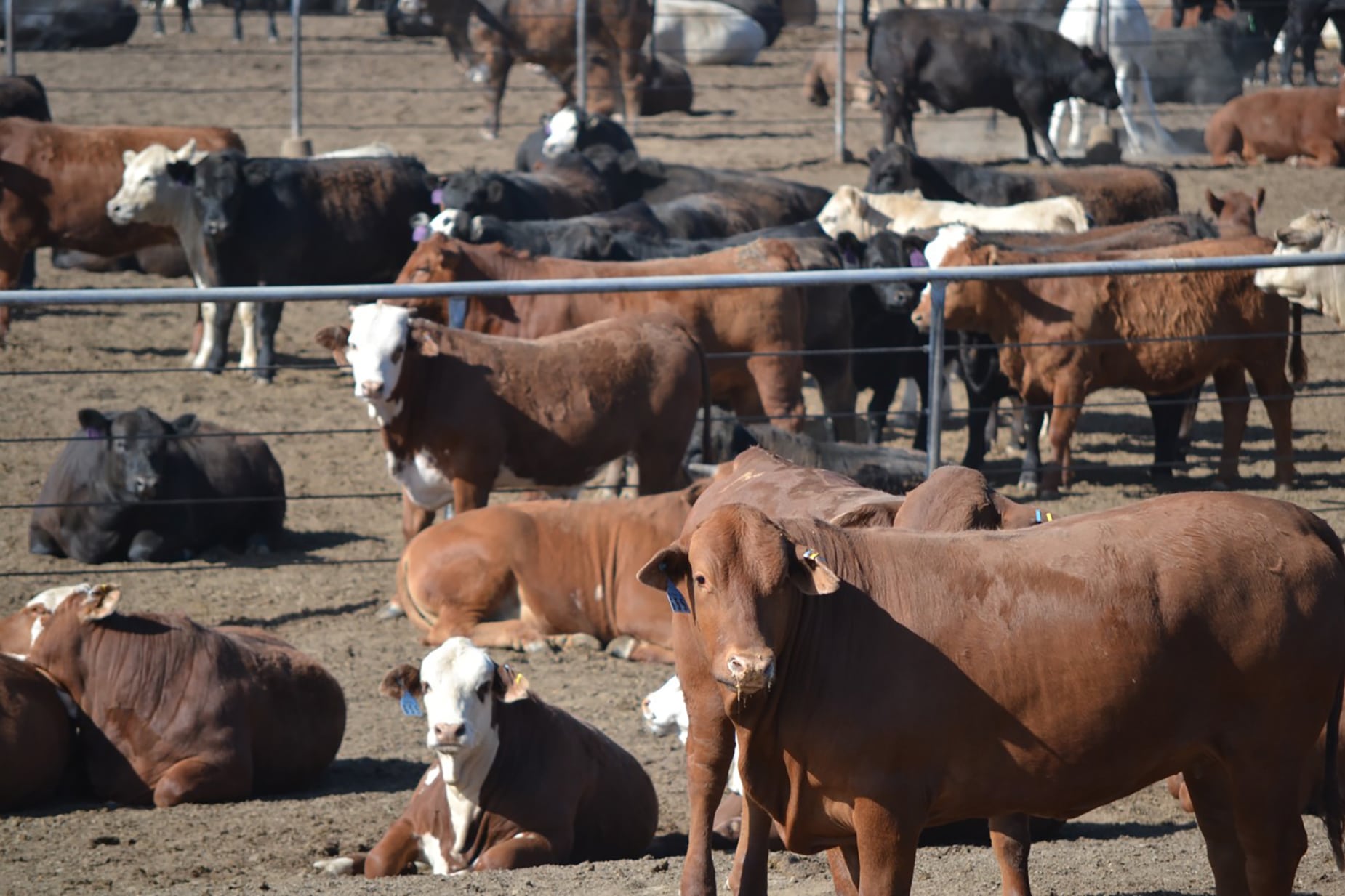
Drought-driven feed costs, changes in beef processing capacity and increased imports are creating headwinds for cattle markets heading into the final quarter of 2026, according to Terrain Ag analyst Dave Weaber.
After reaching record highs earlier this summer, cattle markets have lost ground, and the outlook for the remainder of 2026 remains uncertain.
By the end of summer, more than 80% of the nation’s cattle inventory was located in areas experiencing abnormally dry or worse drought conditions. Hay prices across the Central and Northern Plains have increased by an estimated $150-$200/ton over roughly 60 days, adding significantly to cow-calf production costs. Those conditions are also making herd expansion more difficult.
Processing Capacity and Border Trade Shift
In his latest market outlook for Terrain Ag, Weaber points to changes in beef processing capacity as another factor shaping the market as the fourth quarter begins.
In August, Tyson Foods closed its plant in Joslin, Illinois, restored a second shift at its Amarillo, Texas, facility and announced plans to seek a buyer for its plant in Pasco, Washington. In September, Cargill reached a labor agreement and restarted its Fort Morgan, Colorado, plant.
According to Weaber’s analysis, net fed-cattle slaughter capacity has recovered by about 4,000 head per day from its summer low. However, capacity remains approximately 7,800 head per day below the level recorded at the same time last year.
The additional capacity coming back online allows existing cattle supplies to be spread across more plants, potentially reducing packers’ bargaining power and providing more leverage to cattle feeders.
Cross-border cattle trade is also gradually resuming following restrictions tied to the New World screwworm outbreak in Mexico.
The Douglas, Arizona, port of entry reopened to feeder cattle and calves from the Mexican state of Sonora, with weekly imports fluctuating significantly during the first three weeks. The renewed trade arrangement is expected to allow approximately 4,000 head per week to enter through Arizona.
The Santa Teresa, New Mexico, livestock port of entry reopened September 24. It is expected to initially accommodate about 3,750 head per week, with the potential to increase to 7,500 to 8,000 head per week. Santa Teresa has historically handled approximately 43% of annual Mexican cattle imports.
Beef Imports Add to Market Uncertainty
Federal trade policy is adding another layer of uncertainty for cattle producers.
An August executive order from President Donald Trump temporarily suspended tariffs on certain beef imports above existing quota limits for 90 days. The move primarily benefits Brazilian beef and allows up to 300,000 metric tons of beef trimmings to enter the United States without the additional 26.4% duties.
However, Weaber expects the actual volume entering under the policy to be considerably less than the maximum allowed. Product availability and shipping constraints are expected to limit imports to about 150,000 metric tons, with approximately 100,000 metric tons of that amount already destined for the U.S. before the import plan was announced. Weaber estimates the additional imports could increase domestic ground beef availability by about 2% to 3%, equivalent to roughly 0.1 to 0.15 pound per capita per month.
He expects that increase to put downward pressure on beef prices, although the impact could be smaller than some headlines suggest. His analysis projects a $15 to $20 per hundredweight decline in boxed beef cutout values and a $9 to $12 per hundredweight decline in fed-cattle prices during the third and fourth quarters relative to a year ago.
Cattle Price Outlook Moves Lower
The combination of trade policy changes, processing-plant developments and shifting investment activity has contributed to a sharp decline in live-cattle and feeder-cattle futures since June.
Weaber notes that speculative investment moved away from cattle futures as crude oil prices rallied amid renewed U.S.-Iran tensions. Without stronger support from commodity hedge funds, he expects a return to early-summer futures highs to take considerable time and remain vulnerable to new developments.
There are some signs of stability in beef prices. After several volatile weeks in August, choice boxed beef cutout values appear to have found support in the $375 to $380 per hundredweight range. Prices for ribeyes and strip loins have remained exceptionally strong, while weakness in chuck and round cuts has contributed to recent declines in overall boxed beef values.
Weaber projects five-area fed steers will average $230 to $235 per hundredweight during the third quarter, about $30 below his previous forecast. Fourth-quarter prices are expected to average near the same range.
Those prices could result in unhedged losses of $200 to $250 per head for cattle marketed during the third quarter. Returns in the fourth quarter could range from slight losses to near break-even.
Feeder cattle prices are expected to trade mostly sideways through the end of the year, with projected averages of $340 to $350 per hundredweight in the third quarter and $350 to $370 in the fourth quarter.
For 450-pound steer calves, Weaber anticipates a wide price range during the third quarter, from approximately $540 per hundredweight early in the period to $420 later on. Average prices across the third and fourth quarters are projected at $465 to $480 per hundredweight.
Overall, Weaber’s forecasts represent a substantial reduction from earlier expectations, with prices expected to move closer to year-ago levels.
###
Terrain Ag