

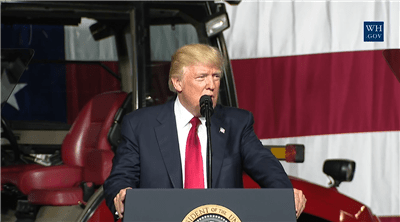
In a dramatic shift on trade policy, President Donald Trump announced Wednesday an immediate increase in tariffs on Chinese imports to 125%, while simultaneously placing a 90-day pause and reduction on tariffs for most other U.S. trading partners. The decision marks a recalibration of the administration’s approach to global trade amid rising market pressure and growing concerns from domestic industries, including agriculture.
“Based on the lack of respect that China has shown to the World’s Markets,” Trump wrote on Truth Social, “I am hereby raising the Tariff charged to China by the United States of America to 125%, effective immediately.” He framed the move as part of an ongoing effort to stop foreign countries from “ripping off the U.S.A.”
However, citing outreach from more than 75 countries interested in negotiations on trade barriers, tariffs, and currency practices, Trump said he was authorizing a 90-day pause for those nations, during which reciprocal tariffs would be reduced to 10%.
The move comes as volatile financial markets, plummeting stock prices, and concerns over rising consumer prices created mounting pressure on the administration. The S&P 500 jumped 9.5% following the announcement, signaling a cautious sigh of relief from investors.
In the agricultural sector, where more than 20% of U.S. farm income is tied to exports, the news offered both hope and uncertainty.
American Farm Bureau Federation President Zippy Duvall responded positively to the temporary relief.
“Farm Bureau appreciates President Trump’s decision to pause the reciprocal tariffs on dozens of America’s trading partners for 90 days,” Duvall said in a statement. “We have been engaging directly with the White House, U.S. Trade Representative and U.S. Department of Agriculture to emphasize the toll tariffs will take on America’s farmers and ranchers.”
Duvall warned, however, that even with the pause, farmers remain exposed to long-term trade instability. “Creating more market challenges puts at risk more than 20% of U.S. farm income,” he said. “We encourage the administration to swiftly resolve trade disputes and pursue strategies that will ensure America’s farmers can continue to stock the pantries of families here at home, and abroad.”
While China faces the steepest penalties, trading partners such as the European Union, Japan, and South Korea will benefit from the 10% tariff—lower than prior rates ranging from 20% to 25%. However, Canada and Mexico remain under a separate 25% tariff directive related to anti-fentanyl measures.
With global negotiations now underway, Treasury Secretary Scott Bessent said talks would be “bespoke” and tailored to each country. “The only certainty we can provide is that the U.S. is going to negotiate in good faith,” Bessent said, though he denied the market selloffs were the primary reason for the pause—despite conflicting statements from the president himself.
For American farmers already squeezed by high input costs and global price competition, the next 90 days may prove critical. Whether the administration’s pivot provides real stability or just temporary relief remains to be seen.
###
Northern Ag Network – 2025