

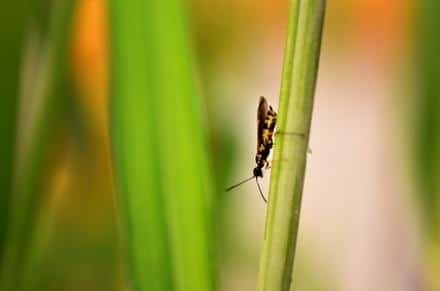
USDA Agricultural Research Service (ARS) scientists have unveiled a promising new biological control strategy aimed at one of the most costly pests facing wheat growers, the wheat stem sawfly.
The wheat stem sawfly (Cephus cinctus) is estimated to cost producers roughly $350 million annually in lost yield. With limited effective control options available, the pest has expanded its range in recent years, causing significant damage to dryland wheat across parts of the Great Plains, stretching from the PNW across Montana and the Dakotas and as far south as Kansas and Colorado.
Montana growers are no strangers to the challenges posed by sawfly pressure, making new management tools especially noteworthy.
Researchers with ARS in Fort Collins, Colorado, and Sidney, Montana, working alongside university partners, have developed and tested a straightforward but effective approach using a native predator to suppress sawfly populations. The team transported wheat straw bales containing day-glow orange parasitoid wasps (Bracon spp.), natural enemies of the wheat stem sawfly, from areas where the beneficial insects were already established into heavily infested regions.

In cooperation with USDA’s Animal and Plant Health Inspection Service (APHIS), nine straw bales were relocated to an ARS field station. From those bales, approximately 67,500 parasitoids emerged and quickly began targeting sawfly larvae in surrounding wheat fields. The parasitoids specifically attack wheat stem sawfly, offering a targeted biological control option without additional chemical inputs.
Researchers say the technique shows strong potential to boost wheat yields in areas experiencing heavy infestations. For Montana wheat producers, particularly those managing dryland systems where sawfly can significantly reduce standability and harvest efficiency, the approach may offer another tool in an integrated pest management strategy.
While additional evaluation will likely continue, the early results suggest that leveraging native predators could become an important, cost-effective weapon in the fight against wheat stem sawfly across the Northern Plains.
###
USDA-ARS