

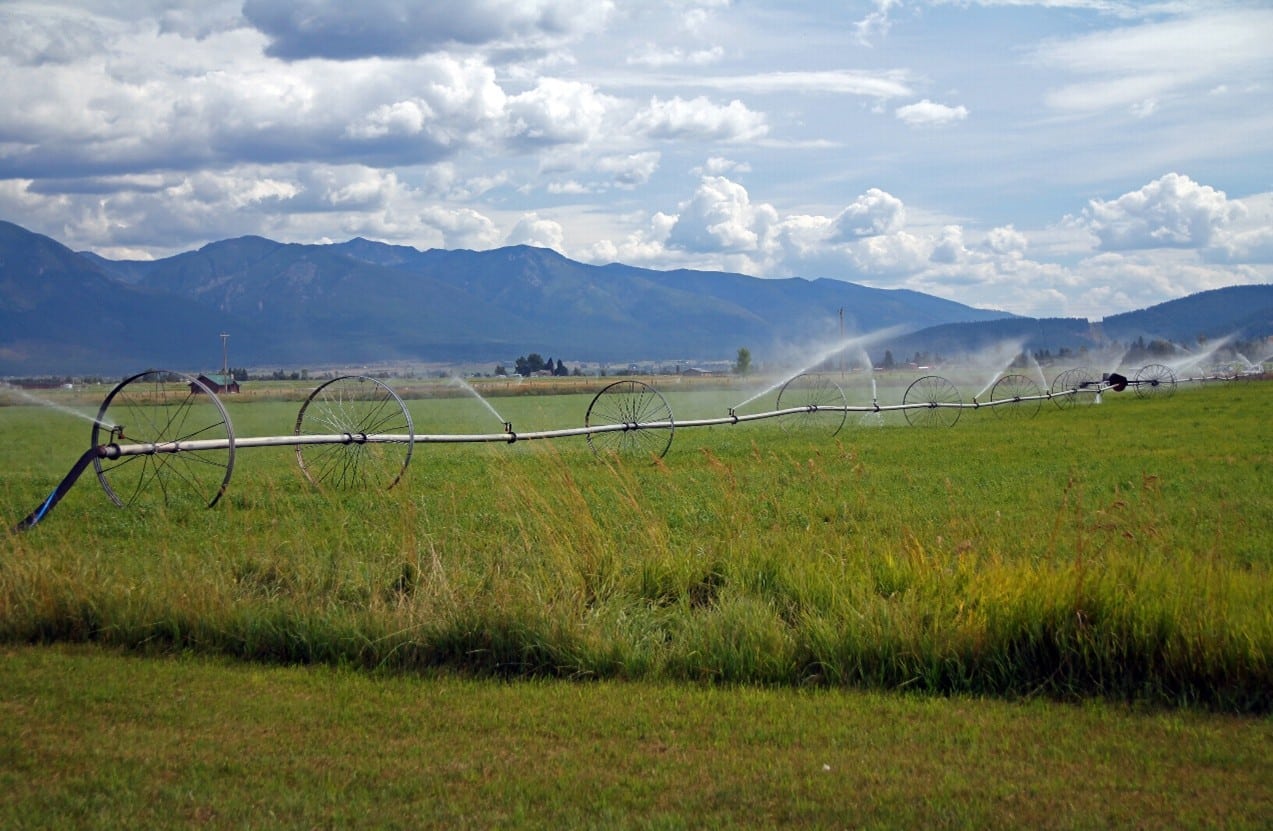
Although only a small portion of Montana cropland is irrigated, the irrigation plays a much larger role in the overall value of the state’s crop production. According to an analysis of data from the 2022 Census of Agriculture, MSU Assistant Professor of Ag Economics Nick Hagerty found that irrigation accounts for roughly 26 percent of the value of crop production in Montana, totaling about $737 million.
Only about 7 percent of Montana cropland is irrigated, but irrigated acres often produce higher-value crops and deliver significantly greater yields than dryland farming. Irrigation allows producers to grow crops such as sugarbeets and can also increase production from crops like hay by enabling multiple cuttings in a single growing season.
Higher yields play a major role in the value difference. For example, while only about 36 percent of Montana hay acreage is irrigated, those acres produce substantially more forage. Irrigated alfalfa fields average 2.8 tons per acre, compared to roughly 1 ton per acre on non-irrigated ground. As a result, irrigated fields account for an estimated 56 percent of the state’s total hay production, even though most hay acres are not irrigated.

Hay is by far the most valuable irrigated crop in Montana, with alfalfa and other hay production valued at about $567 million. Other major irrigated crops include wheat ($67 million), barley ($48 million), sugarbeets ($42 million), and corn ($31 million). Smaller contributions come from crops such as canola, chickpeas, dry peas, lentils, and safflower, which together add about $5.5 million in irrigated production value.
Haggerty’s analysis focuses specifically on crop production and does not include irrigated pasture used in cattle production. While about one-quarter of irrigated land in Montana is pasture, only about 1 percent of total pastureland is irrigated, so irrigation is probably a small share of cattle production.
These numbers illustrate irrigation’s economic importance to Montana agriculture. Although most cropland in the state remains dryland, a significant share of crop output—and the revenue it generates—depends on irrigation.
###
MSU