

Over the past couple of weeks, the inversion of the Choice/Select spread has been a frequent topic in agricultural media. The concern is that when the spread is inverted, it means consumer interest in the lower-quality product is greater than for the high-quality product. In other words, consumers are trading down.
However, livestock market analyst Don Close with Terrain Ag says that, in the current market environment, “the spread is a meaningless measurement.”
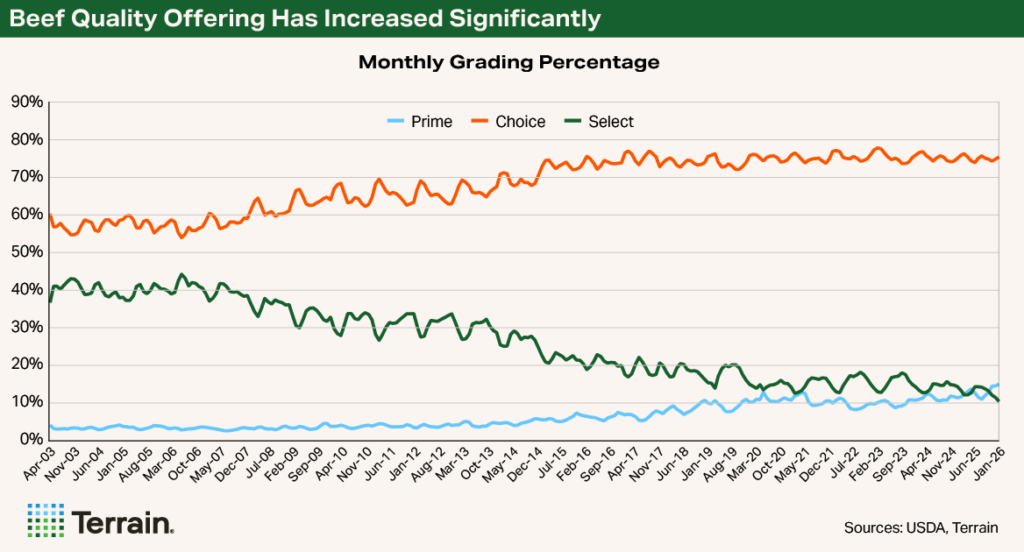
In previous years, an inverted spread mattered. But the grading percentage then was about 60% Choice or better and about 40% Select. And the majority of retail grocery chains carried Select product. There were also no branded beef programs, and the percentage of carcasses grading Prime ranged from 2% to 4%.
Now, retail stores predominantly carry Choice and better. It is also common for the percentage of Prime carcasses to be 10% to 15% and for there to be more Prime than Selects.
Select Supply Shrinking
Why the sudden escalation in demand for Select product?
The main reason is that the supply of Select product has contracted, which can make it appear that there is an increase in demand. The supply went from 50% of graded beef carcasses in the 1990s to early 2000s to about 10% currently. As with any commodity product, as supply contracts, the price increases.
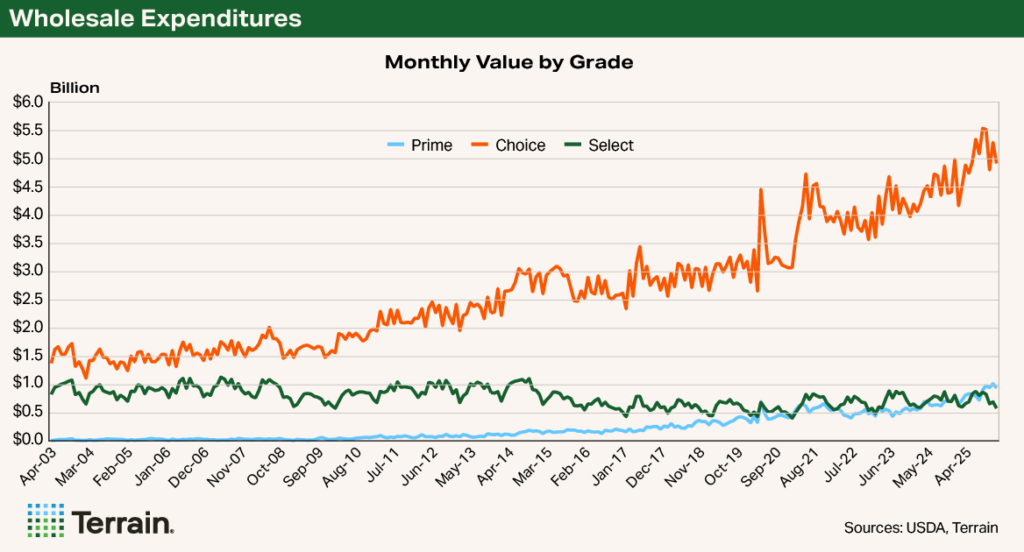
Then there is the fact that we are working with the smallest domestic cattle supply in 70 years. Even with the escalation in lean beef trimmings, the U.S. supply of lean beef for making ground beef blends is exceptionally tight. Processors are searching for any source of lean beef to increase supplies of lean grind materials.
There is also demand for Select products in institution use, primarily hospitals. Select products are also still used in many prepared frozen foods.
Is this going to be a long-term scenario? Is the inversion of the spread going to disrupt the current market? Close is pretty certain neither of those will be the case.
When the day comes that grain prices escalate and the cost of gain exceeds the value of gain, the market may have to take another look. In that case, the economics would discourage feeders from fattening cattle as much, leading to more Select beef, a lower Select price, and a higher Choice price.
Currently, with cost of gain running around $1/lb. and the value of gain approaching $2.50/lb., the inversion of the spread will not be a market-disrupting factor.
What Should Cattlemen Watch Instead?
A better measurement, Close argues, would be a Choice/branded beef cutout or a Choice/Prime spread.
The last time the USDA Beef Grading Matrix was updated or changed was in 1997. At that time there were no branded beef products.
Close says, the grading matrix needs to be updated to incorporate all beef in the upper one-third of Choice and better.
Consumers have proven their demand for ultra-high-quality beef. First, when Certified Angus Beef products were introduced in grocery stores, and again when grocery stores started carrying Prime products during the COVID-19 pandemic. Now, protein diets have become the craze. The American consumer is not going to go back to eating a largely Select-based product.
###
Terrain Ag